
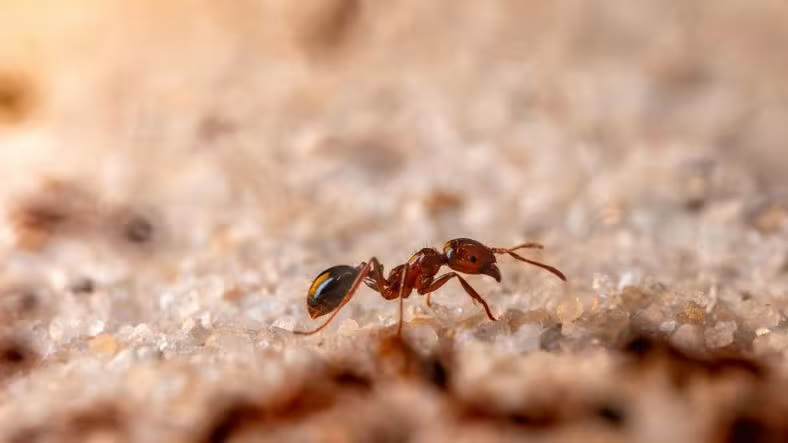
Red imported fire ant (Solenopsis invicta) on soil. A photo alone cannot confirm the species: report suspect ants to NSW authorities. Photograph: NSW Department of Primary Industries
Think you have found fire ants?
Leave the nest alone. Take a safe photo or video and report it to NSW authorities. Do not spray it or book a regular pest treatment for suspected fire ants. Call 000 in an emergency.
1800 680 244Quick answer
Have fire ants been found in Sydney?
Yes. Red imported fire ants were detected at the Enfield Intermodal Logistics Centre in Sydney's inner west in September 2026. The nest was treated, but surveillance and treatment continue around the site. If you suspect fire ants, do not touch or treat the nest. Take a photo from a safe distance and call the NSW Biosecurity Helpline on 1800 680 244.
Red imported fire ants are a health and biosecurity concern, not an everyday kitchen ant problem. This guide explains the Enfield detection, what Sydney residents should watch for and how to report a suspected nest safely. Information reflects the supplied October 2026 update; check the NSW Government advice linked below for current boundaries and restrictions.
What happened at Enfield?
On 23 September 2026, federal biosecurity officers carrying out routine surveillance found suspect ants at a freight facility in Strathfield. They were confirmed as red imported fire ants (Solenopsis invicta) on 25 September. The location was the Enfield Intermodal Logistics Centre in Sydney's inner west.
Officers found one nest made up of two mounds on concrete and treated it. Genetic testing indicated the ants were not linked to the south-east Queensland infestation. Authorities have not confirmed how they arrived. Sydney has dealt with an isolated detection before: fire ants found at Port Botany in 2014 were eradicated.
The draft's October update reports that no further nests had been found following treatment. That is not an all-clear for surrounding areas: official advice still calls for surveillance because ants may have spread beyond the original site.
Which Sydney suburbs are in the fire ant zone?
The supplied October update describes a 2 km zone covering parts of Enfield, Belfield, Croydon Park, Greenacre, Chullora, Belmore, Strathfield, Strathfield South, Rookwood and Lakemba. This list has not been independently confirmed against a current official boundary map. A suburb name does not mean every address is within the zone: check the NSW Government map for your property.
The supplied update lists treatment of publicly accessible areas from 19 October to 30 November 2026, weather permitting, with signage and no re-entry restrictions. These dates and conditions have not been independently confirmed. Check current NSW advice and follow directions posted at the location.
A Biosecurity Control Order was expected by the end of October 2026, focusing on businesses moving carrier materials such as soil, turf, building materials and nursery plants. Dates and restrictions can change, so check the current NSW Government advice before moving materials.
Does this affect Western and South-West Sydney?
Blacktown, Liverpool, Penrith, Campbelltown and the Narellan area are outside the reported Enfield zone. That does not mean people elsewhere in Sydney should ignore suspect ants.
Fire ants can be transported in shipping containers and moved soil, mulch, turf and nursery materials. Stay alert when checking your yard, but do not approach or disturb a suspicious mound. Report concerns rather than trying to confirm them yourself.
What do red imported fire ants look like?
Workers are roughly 2 to 6 mm long, dark reddish-brown, with a darker brown-black abdomen. Their nests can appear as flat patches of soil or mounds up to about 40 cm high, often with no obvious entry or exit hole.
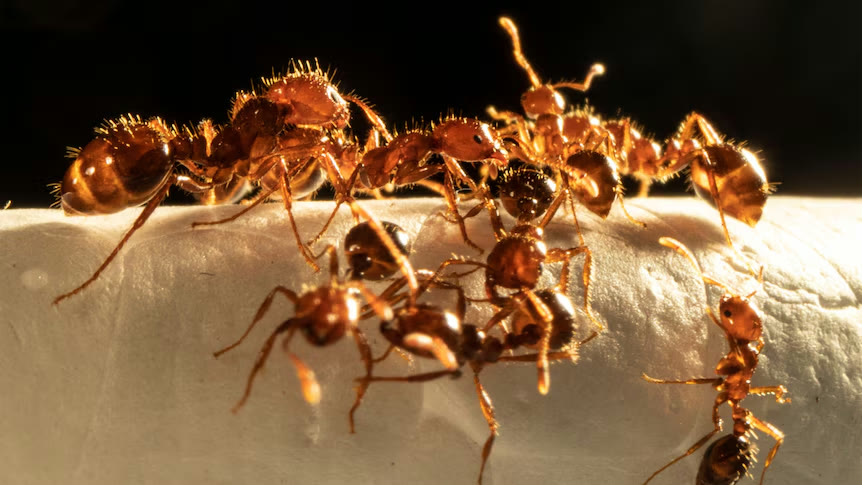
They can swarm aggressively and sting repeatedly when disturbed. Do not test this behaviour by poking a nest. Potential nesting places include lawns, median strips, driveways and roadside gutters.
Colour alone is not reliable identification. Other ants can look reddish, and a mound by itself does not confirm fire ants. Take a photograph only if you can do so safely, and let NSW authorities identify them.
How are fire ants different from ordinary household ants?
Argentine, black house and ghost ants commonly enter kitchens and bathrooms looking for food and moisture. Red imported fire ants pose a different risk: they can nest outdoors in soil, swarm when disturbed and deliver repeated stings.
Location alone cannot rule out fire ants, and an ant trail is not a species diagnosis. If you are uncertain, do not spray. Photograph from a safe distance and contact the NSW Biosecurity Helpline on 1800 680 244.
What should I do if I think I have found fire ants?
1. Leave it. Do not destroy, disturb or treat the nest. Keep people and pets away.
2. Snap it. Take a clear photo or video from a safe distance, only if it is safe to do so.
3. Call it. Call the NSW Biosecurity Helpline on 1800 680 244 or use the reporting information on the NSW Government fire ants page below.
Fire ants are prohibited matter in NSW. Do not treat, move or possess suspected fire ants without authorisation. Spraying a suspected nest yourself, or booking a routine pest treatment for it, is not the right response. We would rather point you to the authorities than take the wrong booking.
What if I get stung by a fire ant?
Stings can cause burning pain, redness and itching. Small blisters may form within 48 hours. Move away from the ants, wash the area gently with soap and cool water, and apply a cold pack for pain and swelling. Do not scratch or break blisters.
Call 000 immediately for signs of a severe allergic reaction, including trouble breathing, swelling of the face or throat, widespread hives or feeling faint. Seek urgent medical advice for concerning symptoms such as chest pain, nausea or heavy sweating. See a doctor if symptoms worry you or you have a history of severe allergic reactions.
Pets are also at risk, particularly around the nose, mouth and ears. Move your pet away safely and call a vet promptly. Facial swelling or breathing difficulty needs urgent veterinary help. This is general information, not medical advice.
What about the ants in my kitchen right now?
Once suspected fire ants have been ruled out, ordinary household ants are a different job. Spring brings increased insect activity, and trails around kitchen benches, bathrooms and window frames often point to common household species.
Wipe up food and drink spills, seal pet food and sweet items, fix leaking taps, and seal gaps around doors, windows and pipes. These steps reduce attractants, but an established colony may need targeted ant control rather than repeated surface spraying.
PestGuard Sydney provides household ant control and general pest control for homes and businesses in Narellan, Campbelltown, Liverpool, Blacktown, Penrith and surrounding suburbs. For ordinary household ants, request a quote. For suspected fire ants, report to NSW authorities first.
Fire ants in Sydney: frequently asked questions
Are there fire ants in Sydney?
Red imported fire ants were detected at Enfield in September 2026. The nest was treated, with ongoing surveillance and treatment around the site. Check NSW Government advice for the latest status.
Which suburbs are affected by fire ants in Sydney?
The supplied October update lists parts of Enfield, Greenacre, Strathfield, Strathfield South, Belfield, Chullora, Rookwood, Croydon Park, Belmore and Lakemba within a reported 2 km zone. This list is not independently confirmed; check the current NSW Government map for your address.
What do fire ants look like?
Workers are 2 to 6 mm long, reddish-brown with a darker abdomen. Nests may be flat soil patches or mounds with no obvious entrance. Appearance alone cannot confirm the species; report suspected ants for identification.
What should I do if I find fire ants?
Leave the nest alone, take a photo or video only from a safe distance, and call the NSW Biosecurity Helpline on 1800 680 244. Do not disturb or treat it.
Can I treat fire ants myself or hire a pest controller?
Do not organise routine pest treatment for suspected fire ants. They are prohibited matter in NSW and must not be treated, moved or possessed without authorisation. Report them to the NSW Biosecurity Helpline on 1800 680 244.
Are fire ants dangerous?
Yes. They can swarm and sting repeatedly, causing burning pain and sometimes severe allergic reactions. Call 000 for breathing difficulty, face or throat swelling, or other signs of a severe reaction.
How did fire ants get to Sydney?
Authorities have not confirmed the arrival pathway. The detection was at a freight hub, and genetic testing indicated it was not linked to the Queensland infestation. Fire ants can travel with freight and moved soil or landscaping materials.
Sources and current advice
Quick takeaways
- The Enfield nest was treated; surveillance continues around the site.
- Check the official zone map, not just the suburb name.
- Do not disturb, spray or move suspected fire ants.
- Take a safe photo and call 1800 680 244.
- Call 000 for a severe allergic reaction.
- Routine household ant treatment is not fire ant treatment.
For ordinary household pests
Keep reading
Termites
Termite Swarming Season in Sydney: What to Watch For
Flying termites after a warm, humid evening are not a random event, they are a colony telling you it is established nearby. Here is what that means for Sydney homes.
Read guideSeasonal
Spring Pest Activity Across Western & South-West Sydney
Every spring the same call comes in: ants overnight, webs on the eaves, wasps at the back door. Here's why it happens all at once, and how to get ahead of it.
Read guide